
Two jars can highlight nigella while containing very different products. In the first, the link to the plant comes from the bees' foraging. In the second, seeds are incorporated into the honey after harvest. This distinction may seem simple, but it changes both the composition, the regulatory designation, and what the consumer actually eats.
What does "nigella honey" really mean?
In common usage, the expression can cover two constructions. It can refer to honey whose floral origin is attributed to nigella: the bees have then collected nectar in an environment where Nigella sativa grows. It can also refer, more broadly, to a preparation in which nigella has been added to the honey in the form of seeds or another ingredient.
Floral origin
Nigella comes from foraging
No seeds are necessarily present. The link to the plant rests on the botanical origin attributed to the honey and on the characteristics that allow it to be justified.
Composition
Nigella is added to the jar
The seeds appear in the list of ingredients, remain visible, and are consumed with the honey. The product then becomes a honey-based preparation.
European regulations precisely define floral origin. An indication such as "honey from [plant]" is only justified if the product comes entirely or essentially from the stated origin and possesses its organoleptic, physico-chemical, and microscopic characteristics. The commercial name, on its own, therefore does not prove botanical origin.
The same regulations also protect the word "honey". The DGCCRF reminds that no food ingredient can be added to a product sold under this designation alone. As soon as seeds enter the jar, a descriptive formulation such as "preparation based on honey and nigella seeds" becomes necessary.
What pollen analysis reveals, and what it does not say on its own
Pollen analysis of honey, or melissopalynology, consists of identifying and counting the pollens present in a sample under a microscope. The resulting spectrum constitutes a fingerprint of the foraged environment. It helps to check the stated botanical and geographical origins and can reveal the dominant plant families.
However, this method requires expert interpretation. Not all plants deposit their pollen in honey with the same intensity: some pollens are underrepresented compared to the collected nectar, while others are overrepresented. Enrichment can also occur in the hive, during extraction, or through airborne contamination.
The general threshold of 45% characteristic pollen, sometimes cited to speak of monofloral honey, is therefore not a universal rule that can be mechanically applied to all plants. The expected references vary depending on the taxon. Without a validated reference value for the plant studied and without the other laboratory results, an isolated reading can lead to a hasty conclusion.
Less than 1% nigella pollen: how to interpret this result?
Maison Nigelle consulted the pollen analysis of a sample marketed under a name referring to nigella. In this report, the pollen attributed to Nigella represented less than 1% of the identified pollens, while other plant families were overwhelmingly dominant.
This finding is enough to show that an evocative name does not, on its own, provide information about the pollen composition. However, it does not allow directly converting this "less than 1%" into a share of nectar, nor automatically conclude fraud. To judge the conformity of the claimed floral origin, it would be necessary to have the full report, the method, the chosen taxonomic identification, references adapted to Nigella, and complementary analyses.
The right reaction is therefore neither to believe the label without examination, nor to condemn a honey based on an isolated figure. It consists in asking what the name exactly covers: a documented floral origin, a vaguer commercial use, or the actual addition of nigella in the recipe.
Nigella pollen and seeds: two different food realities
The pollen found in a honey naturally accompanies the work of the bees. The seed is a whole plant material voluntarily added to a preparation. Their origin, their quantity, and their place in the product are not equivalent.
| Criterion | Floral origin linked to nigella | Preparation with honey and seeds |
|---|---|---|
| Origin of nigella | Foraging on flowers present around the hives. | Seeds voluntarily incorporated after the honey harvest. |
| Presence of seeds | Not necessary; the product may contain no seeds. | Yes; they must appear in the list of ingredients. |
| Observable element | Microscopic pollen studied in the laboratory. | Seeds visible and perceptible in the preparation. |
| Designation | "Honey" completed by a floral origin if the regulatory conditions are met. | "Preparation based on honey and nigella seeds" or equivalent descriptive designation. |
| What must be checked | Justification of botanical origin and sensory, microscopic, and physico-chemical consistency. | List of ingredients, declared proportion if applicable, origins, and labeling conformity. |
Why Maison Nigelle chose to add the seed itself
Maison Nigelle chose a composition that does not make the presence of nigella dependent solely on the foraging environment. The preparation combines a multi-flower honey harvested in France with Nigella sativa seeds from Ethiopia. The two supply chains are distinct before their union in the jar.
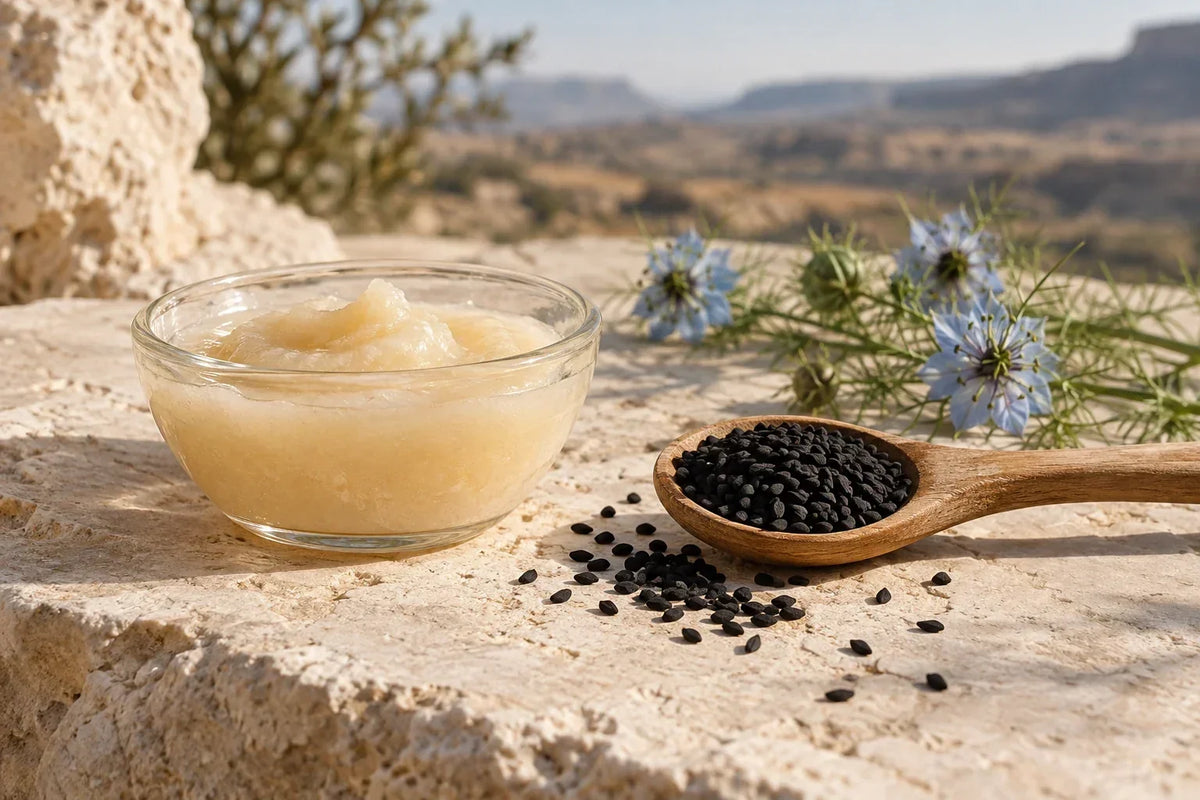
This recipe provides a verifiable answer to a simple question: is there really seed in the product? Here, yes. The seeds are indicated in the composition, visible in the creamy mass, and perceptible under the spoon. It is neither a nigella flavoring nor the mere microscopic presence of a pollen.
This choice does not allow promising a health effect and does not make the preparation "superior" to all floral honeys. It precisely defines what is consumed. The honey brings its sweetness and its creamy texture; the seeds bring their substance, their crunch, their delicate bitterness, and their peppery note.
How to know what a jar really contains
Before choosing, four checks provide more information than a photograph or a name placed in large letters on the label.
- Read the exact designation. "Honey" and "preparation based on honey" do not refer to the same composition.
- Look at the list of ingredients. If seeds have been added, they must appear there.
- Identify the two origins. The country of honey harvest may be different from the country where the nigella is grown.
- Ask for the context of the analyses. A pollen percentage is interpreted with the method and the other characteristics of the honey.
This reading avoids two opposite confusions: believing that every product called "nigella honey" contains seeds, or thinking that a floral honey is necessarily misleading because its pollen proportion appears low. In both cases, precision comes from documented facts.
Frequently asked questions about nigella honey
Does nigella honey necessarily contain seeds?
No. A floral designation refers to the nectar collected by the bees and does not imply the addition of seeds. To know if the jar contains them, you must read its designation and its list of ingredients. Added seeds transform the product into a honey-based preparation.
Can the floral origin be determined with the pollen percentage alone?
Not always. Pollen analysis is a major method, but some pollens are naturally underrepresented or overrepresented. A solid interpretation also takes into account the sensory and physico-chemical characteristics as well as the references specific to the plant being sought.
Does less than 1% nigella pollen mean there is no nigella?
This result indicates a very low pollen presence in the analyzed sample, not an absolute absence. It does not directly measure the quantity of nectar and is not enough, without the full report and complementary data, to qualify the floral origin or the conformity of the product.
Why is the Maison Nigelle product called a "preparation based on honey"?
Because nigella seeds are added to the multi-flower honey. The designation "honey" is reserved for the product from the hive without any other added food ingredient. A descriptive designation therefore makes the composition of the jar explicit.
Sources
- DGCCRF, "Honey labeling: the rules to know", definition, designation, and floral origin indications.
- Directive 2001/110/EC on honey, criteria applicable to floral or botanical indications.
- International Honey Commission, harmonized methods of melissopalynology, method and limits of interpretation of the pollen spectrum.
- Maison Nigelle, product sheet for French white honey with Ethiopian nigella seeds, composition, sizes, and sensory profile.
Share: