



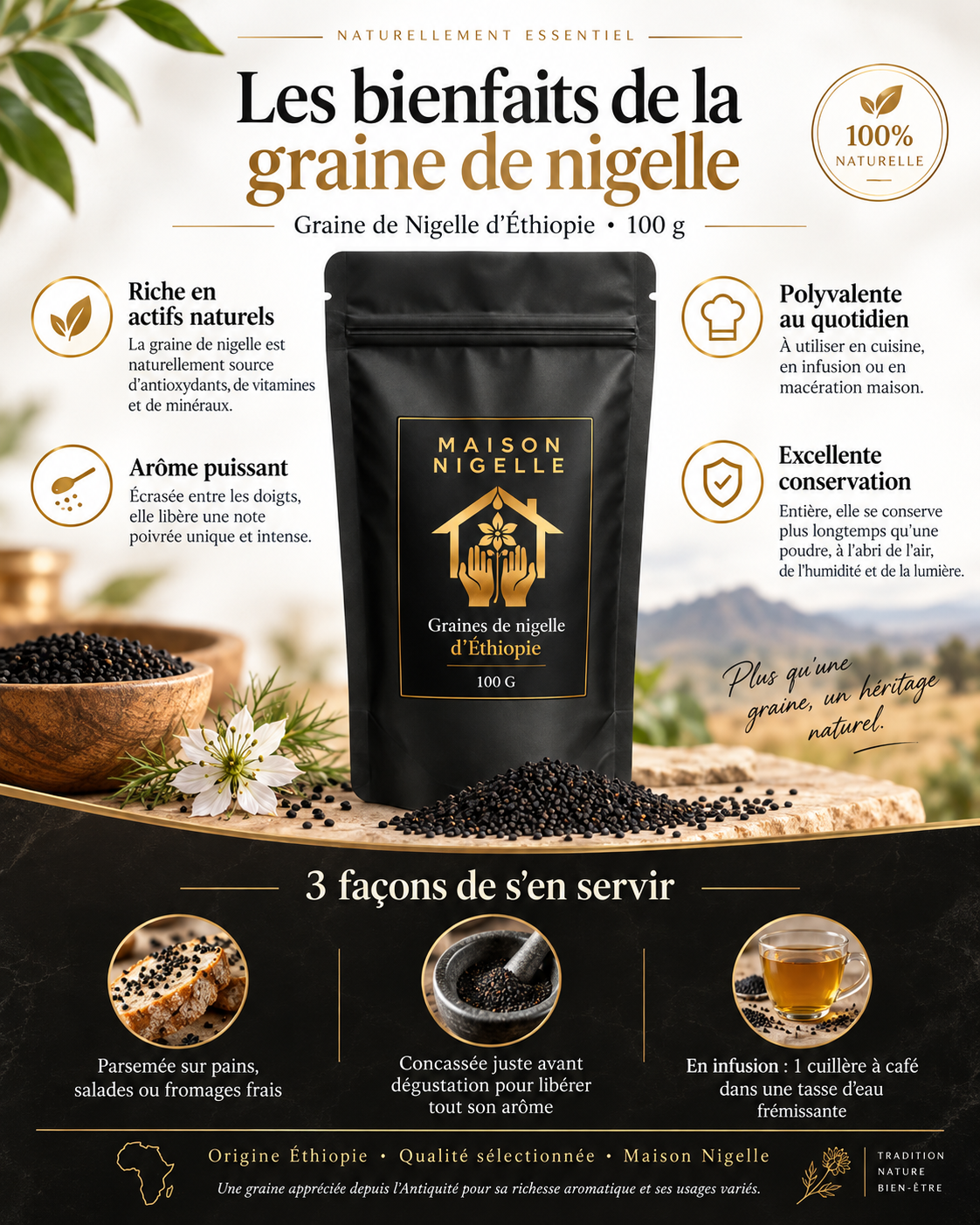

Nigella seeds come from two origins, Ethiopia and Morocco, and are delivered whole and untreated in airtight packaging. They are neither roasted nor ground before shipping, leaving you with the choice of chewing them, crushing them, or grinding them at the exact moment you prepare your recipe.
From the sealed bag to the plate: what matters at each stage
When sealed, the bag retains its aroma for several months. Once opened, it loses intensity, which becomes apparent in its scent after a few weeks: a fresh black seed releases a distinct peppery note when crushed between the fingers, while a stale seed smells of almost nothing. Once ground, it oxidizes within a few days, which is why it should be ground just before serving. If heated for too long, it dries out and becomes bitter, while a few seconds in the pan are enough to bring out its aroma. It is this bitterness that explains its pairing with sugar and the principle of nigella honey.
Storage and labeling
Reseal the bag after each use and store it in a dry place at a stable temperature, away from direct light. An opaque container offers better protection than a clear jar left on a countertop, and an open bag in a damp kitchen loses its aroma faster than one stored in a dry cupboard. Do not grind the seeds in advance, even for two days. To compare the two origins over time, keep them in separate containers and retain their labels: the country and the opening date will remain identifiable.
Ethiopian or Moroccan seeds on the plate
The difference between the two origins can be tasted by crunching one seed of each: the Ethiopian seed, sold in 100 g bags, has a sharper bite and leaves a longer-lasting bitterness on the palate. The Moroccan seed is more subtle and blends better into everyday dishes. In cooking, both can be sprinkled on bread before a brief stint in the oven, on fresh cheese, or on roasted vegetables just before serving. Start with a small amount to assess the intensity before adding more, as it is difficult to remove seeds once they have been mixed into a preparation.
Buying nigella seeds: what you need to know beforehand
Are nigella and black cumin the same plant?
The name black cumin is commonly used to refer to nigella, Nigella sativa. It is often confused with true cumin, Cuminum cyminum, which belongs to a different botanical family.
Should the seeds be ground before consumption?
This is not necessary. Whole, they retain their aroma for longer. Ground, they distribute more evenly in a preparation but oxidize within a few days, so they should be ground at the last moment.
Which origin should you start with?
The Moroccan variety, which is milder and blends into a dish without overpowering it. Ethiopian seeds come next, once you are no longer surprised by the bitterness and peppery note when tasting them.
Should the bag be kept in the refrigerator?
No. A dry, dark cupboard away from any heat source is suitable. Refrigeration is not necessary, and the moisture in the refrigerator can penetrate a bag that has not been properly resealed.